Tuesday, April 27, 2021

Cancel Culture isn't real...sorta

  When it comes to free speech conversations, we often talk about “cancel culture” and the harm deplatforming does to people and their careers. Time and time again, there has been public outcry when (usually bigoted) people are held accountable for the things they do and say. We give more grace to the white supremacists, racists, and transphobes. For example, Milo Yiannopolous speaking at Berkeley sparked protests on campus in 2017 but got a supportive tweet from President Trump. Gina Carano was heavily supported even after months of her problematic social media history. Then when an antisemitic Instagram post got her fired from the Mandalorian, she was just as quickly picked up by Ben Shapiro and the Daily Wire, who all decried Cancel Culture. 
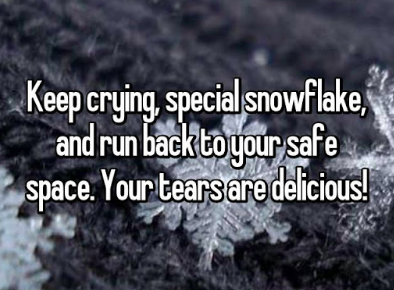
cringe ngl

There are many other examples of instances like these, and sure they may get fired from one thing, just to get picked up by the next. 


According to an article by Vox, Georgetown University’s Free Speech Project suggested that the right’s crying about Cancel Culture is overblown. The project’s leader, Sanford Ungar writes, “Most of the incidents where presumptively conservative speech has been interrupted or squelched in the last two or three years seem to involve the same few speakers: Milo Yiannopoulos, Ben Shapiro, Charles Murray, and Ann Coulter “ all people who been mask off racist AT LEAST once in the past. 


However, this isn’t as clear-cut as left-wing adjacent people have the upper hand. In fact, it’s more like the opposite. As conservatives and right-wingers complain that they’re the ones who were canceled, we shouldn’t forget the red scare and the subsequent blacklisting of anyone who was believed to be a communist or the letter Martin Luther King Jr received that he suggests he commit suicide, to his literal assassination. Or even the black panther party being labeled a terrorist organization, being infiltrated and “neutralized”,  its leaders and members assassinated, imprisoned and/or exiled. It all feels like being canceled to me. 


(also ‘canceled’ being a term that came from black lgbtq+ people that now conservatives are weaponizing is not lost on me)


More recently while Qanon conspiracy theorists, Trump supporters, and fox news all complain about cancel culture, a lot of them still have platforms, shows, and other apps and places to congregate. Facebook, Twitter, and Instagram still have some vile people on their platforms and actively do nothing about them.


Meanwhile, it’s the people on left being targeted. 


Ferguson activist and former State Rep, Bruce Franks Jr was peacefully protesting in Arizona when he was arrested, he was charged with “Aggravated assault on police, resisting arrest, rioting, criminal trespassing, and unlawful assembly.” 


When the officer’s body camera video was reviewed there was audio of officers targeting Bruce by name, “And keep those two in front, Bruce Franks, take him into custody, red shirt, these two right here, two in custody, Bruce Franks.”


The charges were later dropped against Bruce.


Other incidents include Facebook and Twitter purging leftist voices randomly. Media Matters has done studies, “showing that conservative content on Facebook has greater content than other engagement”


Or the time a self-identified communist was visited by California Highway Patrol on behalf of the capitol police for ‘threatening’ Alexandria Ocasio-Cortez, but simply tweeted about her “disappointing answer in response to a question about Palestine/Israel”


According to intercept reporter, Ryan Grim, AOC said “They did not report this” and “asked Capitol Police to look into what happened”


Grim follows up, that even though they don’t know who reported the tweet, they know that AOC didn’t report it. 


The Intercept also reports of a Political Science professor, Pete Hatemi, at Pennsylvania State University who was reached out to the faculty advisor for a group called Young Americans for Freedom. A group that “were declared white supremacists, believers in the QAnon conspiracy theory, and supporters of the Ku Klux Klan and the Proud Boys. Some were involved with neo-Nazi activist Richard Spencer. And at least one had participated in the assault on the U.S. Capitol” 


When he declined the group lashed out, publishing the email on a conservative website, Campus Reform. Following this was a lot of hate mail, some even threatening violence. However Hatemi was not the only one. Isaac Kamola, assistant professor at trinity college closely watches the site and surveyed 338 people, they found “that at least 40 percent of respondents received “threats of harm” following a Campus Reform article, mostly via email and social media but also often by phone, text message, or postal mail. One professor reported receiving thousands of emails, many of them laced with violent, racist, and sexist comments,”


Other findings include:


“In the most extreme cases, he added, online trolls published the professors’ personal information online, forcing them to change their phone numbers, leave their homes, and retain security. Less than half the people surveyed by Kamola reported receiving support from their universities’ administrations, and more than 12 percent reported facing disciplinary action as a result of a Campus Reform story. Three people said they lost their jobs.”


And that “Black professors were disproportionately targeted” 


This is the problem, so often black and other marginalized voices are targeted by these anti cancel cancel clubs. People who supposedly hate the “woke mobs”, fighting back with unwoke(?) mobs. Using the exact tactics they say they hate, to censor others. Though it’s against black, brown, and queer people so I guess that makes it okay. There are actual people being censored and “canceled” and it’s not the people crying about it on national tv and to millions online. 

Monday, April 26, 2021

Fortune Telling & Free Speech


In an act of complete self-indulgence, I decided to do my final(?) blog post on something that didn't involve Nazis or alt-right conservatives or acts of blood-boiling injustices (at least hopefully, ahaha): fortune telling. Fortune telling is actually a pretty controversial issue in regards to free speech laws, but first, a little history.

Card fortune telling, or cartomancy, as we know it today is often traced back to 16th/17th century French woman Marie Anne Lenormand, who rose to fame among social elites of the time and gave readings to people such as the wife of Napolean, Robespierre, and Jean-Paul Marat. However, fortune telling has existed long before Lenormand, popping up in ancient Chinese, Egyptian, and Babylonian history. Fortune telling has a paradoxical relationship with religion, as many (especially the Catholic church) find it blasphemous to claim to know a future that only God can know, but at the same time fortune telling is often based off religious ideas and can even serve as a way for people to become interested in joining a religion.

Fortune telling can at times shift from a fun tourist attraction to a predatory way of making money, falling into the same category mediums and most televangelists are put into in that they can use a vulnerable person's beliefs against them and scam them out of a lot of assets. This has influenced some states in the US to outlaw fortune telling or prohibit people to engage in this kind of activity under the name "fortune teller." In New York and Pennsylvania, for example, it is a misdemeanor to claim that you actually have the power to tell the future and require payment to do so; one can only charge money for fortune telling if it is made clear that it is just entertainment.

Many fortune tellers have used the free speech defense when accused of illegal activity, but courts have largely ruled against them in the past. Davis v. The State of Ohio, a case that made it to the Ohio Supreme Court, upheld that Gertrude Davis was guilty of fortune telling even though she argued she was participating in freedom of expression. The Supreme Court denied hearing about the Davis case and has not had a case dedicated to the legality of fortune telling, the closest they came to it was the 2015 Reed v Town of Gilbert case where the Court ruled it was unconstitutional to discriminate against signs based on the content of them. This is related because many fortune-telling bans are rooted in regulating based on content, so there's a chance if a case were to make it to the Supreme Court it would be ruled unconstitutional to ban fortune tellers.

Even without the Supreme Court's ruling, however, some states have recently gone back on previous rulings against fortune telling. In 1998, the 8th US Circuit Court of Appeals ruled that Nebraska could not enforce a law banning fortune telling in the case Argello v. City of Lincoln. In Rushman v. City of Milwaukee, a similar ban was denied, the court there saying that "if the City could ban any statement or belief debunked by science, the First Amendment would be a cruel hoax."

Do you think that bans on fortune telling violate free speech/expression? Do you think states have good reason for banning fortune telling? I'd love to know what you think!


Sources:
https://www.britannica.com/topic/fortune-telling
https://www.mtsu.edu/first-amendment/article/1111/fortune-telling#:~:text=In%20Davis%20v.,all%20criminal%20or%20civil%20responsibility.%E2%80%9D
https://daily.jstor.org/surprising-historical-significance-fortune-telling/

Tuesday, April 20, 2021

Anti-Blackness: A Side Effect of Unchecked Freedoms

Over the weekend, the Ball State Debate Team sent four of its top debaters to compete in the USUDC (United States University Debate Championship) British Parliamentary Debate National Tournament hosted by UPenn. After six rounds of competition, the tournament screeched to a halt on its second of three days when Morehouse College, a historically black college, released a statement detailing the anti-blackness, racism, and discrimination their students had faced in rounds and that they were immediately withdrawing from the tournament. After this, colleges (including Ball State) began also withdrawing in solidarity so as not to uphold a tournament that ignored the reports Morehouse had filed. As an Ivy League, UPenn is no stranger to racism, like its counterparts Harvard, Yale, and Princeton to name a few, but that is a unique harm of them hosting a tournament for not only a style of debate that traditionally takes a eurocentric view and features predominantly white male debaters, but also for creating motions of debate that encouraged discriminatory argumentation. The tournament ended up ending early (with no winners) and instead a 6-hour discussion of the harms faced and how to make reparations ensued. 

In light of hearing these stories from debaters and seeing firsthand how other debaters have been insensitive, I began thinking about how anti-black rhetoric (which is separate from pro-white supremacy) is a side effect of the open forum. Within the scope of debate, any argumentation is fair game, no matter how wild. This is beneficial for many debaters who have to debate the "harder" side of many motions; however, in the case of discrimination, it enables rhetoric founded in harmful systems to be perpetuated. Argumentation that claims women are lesser or that black people are less important than white people because they are less in numbers or any number of degrading viewpoints serves only to operate as a means of shock value. The entirely open forum, in this case, is distinctly and uniquely harmful because it creates a space that enables more racist or biased debaters to create argumentation that is actively antithetical to progress. The strength of the argument is put above actual lives and then potentially triggers trauma for these minority groups.


Perpetuated Trauma


One argument people use to lessen the damages of hateful speech is that victims of trauma, particularly racial trauma, are being overly sensitive. What this argumentation ignores is the nuance that exists within trauma and trauma responses. Microaggressions are not "micro", but rather nuanced forms of the larger discussion. Sensitivity acts not as a means to be "upset over anything", but rather is a protection from re-traumatization. Claiming that sensitivity doesn't matter as much because it isn't as impactful only serves to damage discourse. A lot of the black lived experience is traumatic and many have to not only live through traumatic events daily but also are forced to relive it while watching media coverage of anti-blackness and police killings. Trauma responses, therefore, can come from anywhere at any time. A community that has been historically oppressed and marginalized has more shared trauma which takes a greater toll on the community. As white people, we have far less shared trauma because of educational, media, and societal bias and norms that have benefitted us more by design. We come from a privileged life that goes beyond our domination of the workforce. The argumentation that sensitivity could just be "overly" sensitive does come out when white people speak out on their own against something that may not be racist (i.e. someone asking why a clothing brand makes white t-shirts but not black ones. This is a non-issue and typically not racially based) and serve to further trivialize black issues. They believe it can be beneficial because they are using their platforms to speak out, but only draw attention away from black people using their own voices to bring up their trauma.

By enabling an open forum within classrooms, debates, and media, we come to find that anti-blackness is not inherently shunned. Sometimes anti-black rhetoric comes from people who think that they are being inclusive. The people who argue that all lives matter, even in the best case scenario, are arguing that black lives mater, but their lives are not more important than anyone else. While that makes sense, it trivializes the issues the BLM movement protests, that being that black (and other POC) people are unfairly targeted by the police or court system. It's undeniably true, but these "all lives matter" people make the argument that black lives matter inherently claims other lives don't matter, even though they ignore their own hypocrisy and are creating the potential for black trauma to be relived. Constantly diminishing the black experience in order to claim true "equality" perpetuates the idea to many black communities that they are second-rate to white issues. Thus, the cycle of trauma and re-traumatization continues. 

In conclusion, though this blog post has been fairly short, there's an idea within the open forum that saying anything means offensive content does not need to be put in check. Trivializing trauma as something that is an overly sensitive response only serves to create further anti-black discourse and perpetuate the cycle of trauma and re-traumatization. Pain is not objective, but treating specifically black pain as sensitivity makes it so that what matters is what the white people talk about. The onus is on THEM to speak up. THEY have a platform. THEY need to address their biases. What needs to happen is white people need to stop seeing stories about the black experience and posting "I stand with you" or "I understand" because using "I" while someone is sharing their trauma says "I think this is still about me". The selfish rhetoric of anti-blackness is inherently racist because it takes actual harms and traumas from the black community and dilutes the conversation to the interests of whites exclusively. 

Sunday, April 18, 2021

What We Lost in Nazi Book Burnings

Continuing our theme of book-burning and censorship from Fahrenheit 451, I wanted to examine historical Nazi book burnings and the work that we lost--and the implications of that loss. 


Book burnings were an effort to ensure German arts and culture agreed with Nazi ideals (a process called Gleichschtaltung, meaning “coordination” in English). It was largely practiced by German university students, who pillaged public and university libraries for “un-German books”, and then burned their spoils in a great, ceremonial fashion. This included live music and reading “fire oaths”, which detailed why, according to the Nazis, the books deserved their fiery fates.


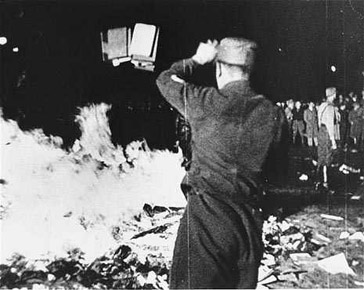
A black and white photograph depicting a SA member throwing books into a fire


The picture above is dated May 10, 1933, and depicts one such book burning on the Opernplatz (a public square) in Berlin. Though indiscernible from one photograph, this event saw over 25,000 books burned to a crowd of 40,000 people. Previously in the year, the Nazi German Student Association’s Main Office for Press and Propaganda called for a nationwide “Action against the Un-German Spirit”, which urged local university chapters to organize blacklists of “un-German” authors, sponsor Nazi public figures to speak publicly, and organize radio broadcasts. This culminated in an outline of what “pure” national German language and culture looked like via the 12 “theses” (a reference to Martin Luther’s 95 Theses), which advocated for “pure” German language and culture (including literature), for universities as a bastion of German nationalism, and against “Jewish intellectualism”. This provided the blueprint for the burnings. 

Among those books burned were How I Became a Socialist by Helen Keller, a blind and deaf author who advocated for women’s suffrage and rights for industrial workers and people with disabilities; Jack London’s The Iron Heel, which depicted a Socialist hero freeing a fascist America; the Jewish author Stefan Zweig’s anti-war tragedy Jeremias, which he wrote in the wake of WWI; and, perhaps most notably, the archives of the Institut für Sexualwissenschaft (Institute of Sexology)--a private research institution founded and led by Magnus Hirschfeld--which consisted of as many as 20,000 books and journals about sex and eroticism, same-sex love, and transgender identity. In addition to its library, the Institut offered housing, counseling, and medical services, including the first modern gender affirmation surgeries in the 1930s. 

In addition to destroying the Institut’s library (and, by 1944, repurposing the building itself into a Nazi office), its list of names and addresses were seized and likely used to aid Hitler’s purge of gay men during The Night of Long Knives in 1934.

Though a few surviving documents are preserved in LGBTQ and Sexology archives in California and Berlin, the vast majority were lost forever, setting LGBTQ research--and particularly transgender research--back by decades. 

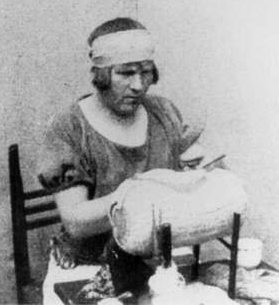
A photo of Dora Richter

We often hear the sentiment (even from well-intentioned, progressive people) that being transgender is a relatively new, even trendy, phenomenon. But this isn’t accurate. Dora Richter (1891-1933) received MTF gender confirmation surgeries in 1922 and 1931, and, though she was the first known person to receive a vaginoplasty, she was one of many transgender people under the Institut. And of course, transgender history goes back much further than the 20s--it’s as old as human history, recorded as early as the Neolithic and Bronze Age--but the point remains: the Nazis destroyed historic research on transgender identity and medicine, which skewed our modern understanding of transgender people. What would trans rights, trans medicine, trans communities, trans-inclusive education look like if this research survived? And how do we handle the fact that we can’t know the answer?


Helen Keller wrote a letter to the German students who burned her work, which was published in the New York Times in May of 1933: 

History has taught you nothing if you think you can kill ideas. Tyrants have tried to do that often before, and the ideas have risen up in their might and destroyed them.You can burn my books and the books of the best minds in Europe, but the ideas in them have seeped through a million channels and will continue to quicken other minds

Tuesday, April 13, 2021

"The Customer is Always... Right?"

 As you know for those who read my previous post, I work at Muncie's local skating rink. A few weeks ago at my part time job there was an order mix up on breadsticks. This older lady ended up throwing an absolute fit because she didn't get the two orders she wanted. I apologized, even though it was not my fault because I was not working alone. I asked this woman if she wanted to wait another 7 minutes and I could make her a new order. She refused and rudely asked for her money back, along with snarky comments under her breath. So, I ended up giving this woman her $3.25 back., sat it on the counter, and helped another person. Next thing I know, the quarter came FLYING at my head. The words that came out of my mouth next were, "do you want your quarter back?" as she walked away shaking her head at me. To make this long backstory short, I ended up getting my boss and he dealt with this woman. She 'apologized' but denied she actually threw the quarter (even though there were eye witnesses to the matter) And yes, I kept the quarter.

The point of the story has to do with the famous slogan "the customer is always right". Over the past few years we have seen countless 'Karens' throwing fits and usually getting their way at  certain places restaurants or anywhere where food is involved. Of course, they have the freedom to speak and say what they want, and because of that 'its my first amendment right'  mentality, they usually do. But isn't there a line that gets crossed? I certainly think throwing something at an employee is a line. I could have used my 'first amendment' rights to call her a bunch of names and thrown something right back at her. But of course if I did so I would lose my job most likely.  

Another incident that goes along with the previous story has to do with yet another rude adult. There were countless customers at the counter and most were children. I was taking an order when this woman appearing out of no where rudely interrupts me and says "I was next, these kids keep cutting me." I started to let her tell me her order, but then made my mind up thinking about the last rude woman who threw a quarter at me and told this lady, "I choose who is next, you should tell this kids to quit cutting and use your adult voice." The lady then rudely proceeds to try and talk to me, calling me a bunch of horrendous names. I think I got under her skin when I used 'my first amendment rights' against hers and chose to ignore her the entire time, taking other peoples orders. My boss ended up being on my side on this incident yet again. Luckily, I have a boss who cares about his employees. Yet there are some places out there who do not because of that 'customer is always right' notion.  

If a person gets their order wrong or does not get their way, does that give them the right to be rude towards the server who is just trying to do their job and who was nice the entire time? I have seen incidents happen countless times in this fashion. I have also overheard many people state along with the complaint 'its my first amendment right' and 'the customer is always right'. Yet, employees at the establishment rarely get to defend themselves with their 'rights'. And if they do, they most likely get fired. Shouldn't employees have the ability to defend themselves if its not derogatory towards the customer? I believe we should have the freedoms of doing so. If a customer is able to be insulting towards an employee, then we at least can be able to defend ourselves based on facts and not as how the customers talk to an employee. That to me is a basic first amendment right, wouldn't you say?


Friday, April 9, 2021

Exodus Cry/TraffickingHub, Modern Day SWERFS and Porn Censorship

Last Summer, in the aftermath of George Floyd’s death and black lives matter protests all over the country, not only were online petitions fighting for justice of many issues were showing up more and more, but abolitionist language became more and more mainstream. And while it does some good in making these ideas more possible, there are also some instances in which it’s not helpful at all. From “Hello Kitty says ACAB”/“ACAB Emily” to Exodus Cry. And you may or may not remember the name Exodus Cry, but you certainly remember their messaging, “Shut Pornhub down” but their mission isn’t just pornhub, according to their website Exodus Cry is “committed to abolishing sex trafficking and breaking the cycle of commercial sexual exploitation while assisting and empowering its victims.” We remember their appeal to emotions, speaking about all of the women who had been harmed and abused. The uploading of content that the people in it didn’t want to be posted for a variety of reasons, the abuse of power and assaults and the Girls Do Porn Lawsuit. They're co-opting the stories and language of victims, progressives, and leftists to push their own agenda.


Which sounds good and normal on paper. Even sex workers say that these events were bad. However, sex workers are also saying otherwise that Exodus Cry isn’t exactly doing all the good they claim to be doing. 


For starters, they don’t want to help decriminalize sex work, which Sex Workers , Human Rights Watch, and Amnesty International have all said will ensure the safety of Sex Workers.


They are a religious organization, they’ve tried to hide it up but their original 2015 mission statement said they were “built on a foundation of prayer and is committed to abolishing sex slavery through Christ-centered prevention, intervention, and holistic restoration of trafficking victims


Their non-profit Id on their tax filings say they are religion-related, but they officially dropped the “Christ” from their mission statement in 2017. 


And Religion isn’t necessarily bad but puritan values have led to regressive views on sex and poor sexual education which definitely plays a part in how they view sex work and sexuality. 


They support SESTA/FOSTA which the Electronic Frontier Foundation describes as, “vague, ambiguous language and stiff criminal and civil penalties are driving constitutionally protected content off the Internet.”


EFF goes on to explain. 


“The consequences of this censorship are devastating for marginalized communities and groups that serve them, especially organizations that provide support and services to victims of trafficking and child abuse, sex workers, and groups and individuals promoting sexual freedom. Fearing that comments, posts, or ads that are sexual in nature will be ensnared by FOSTA, many vulnerable people have gone offline and back to the streets, where they’ve been sexually abused and physically harmed.”


In a whyy.org article, sex worker Danielle Blunt, explains why this has been harmful. “Whenever we lose access to internet spaces, there has been a devastating effect on the community. And the community’s ability to support themselves, to take care of themselves, to make money, and to screen clients and stay safe” 


The same article highlights another organization, The Coalition Against Women in Trafficking, who believe that decriminalizing sex work would be “a gift to pimps, traffickers and the sex industry" 


This isn’t to dismiss the stories of harm and abuse that have been shared. Absolutely no one is saying they are good. Sex workers were the ones to put together petitions holding pornhub and mindgeek accountable for the content on their sites, without doing things to harm other sex workers. 


Sex Workers are the ones that are speaking up for sex workers, survivors, and the overlap of the two. 


Decriminalization should be the goal, to create safer spaces and clearer language surrounding actual trafficking and abuse so those people can be held accountable. Full-service sex workers get arrested for trafficking for simply trying to do their job with another consenting adult. 


We should listen to sex workers instead of trying to censor them because then we end up with celebrities posting their nudes on Instagram while sex workers can’t even post selfies because they’re flagged for solicitation. Censorship is simply not the right answer to fix all of these problems. We’ve already seen the harm it's beginning to do.


To acknowledge the exploitation in the sex industry is to acknowledge the exploitation in every other industry. Did you know that Amazon drivers are peeing in water bottles? Drivers with periods are unable to change their pads or tampons.  My mom developed a tumor on her foot after working with Amazon and standing for long hours. Employees were forced to not speak to one another to ensure efficiency and thwart any attempts of unionizing. And just yesterday after months of trying to unionize, Amazon warehouse workers in Alabama were defeated by Amazon.


The point of this being, all workers are treated terribly. It is unfair to target sex workers because of the ways they are stigmatized, because of stigma we don’t listen to them, we censor them, then talk over them under the guise of helping them. If we truly want safety, we listen to the people at the source directly experiencing the problems. 


Sources:

https://swopusa.org/resources/

https://www.vice.com/en/article/wxqy4z/petition-shut-down-pornhub-trafficking-hub-earn-it

https://www.eff.org/deeplinks/2018/03/how-congress-censored-internet

https://www.eff.org/deeplinks/2019/02/fosta-already-leading-censorship-we-are-seeking-reinstatement-our-lawsuit

https://twitter.com/ProjectWuornos


Monday, April 5, 2021

Pornography and Feminism

 There is a passage in "Defending Pornography" that specifically addressed a branch of feminism and the views they hold on the value of pornography for the movement. I want to site that passage here specifically to discuss.

"An increasingly vocal cadre of feminist women who are dedicated to securing equal rights for women and to combating women's continuing second-class citizenship in our society strongly opposes any effort to censor sexual expression. We are as committed as any other feminists to eradicating violence and discrimination against women; indeed, many of us work directly for these goals every day of our lives. But we believe that suppressing sexual words and images will not advance these crucial causes. To the contrary, we are convinced that censoring sexual expression actually would do more harm than good to women's rights and safety. We adamantly oppose any effort to restrict sexual speech not only because it would violate our cherished First Amendment freedoms - our freedoms to read, think, speak, sing, write, paint, dance, dream, photograph, film, and fantasize as we wish - but also because it would undermine our equality, our status, our dignity, and our autonomy" (Strossen, page 14). 

I would like to first preface this discussion with a statement that I disagree with this passage. I do not agree that sexual expression, through the medium of pornography, is beneficial to the equality of women. However, I want this to be an open discussion and I am willing to see both sides of the argument.

From Strossen's perspective, I understand that pornography is technically protected under the boundaries of the First Amendment. It is a form of expression and many people engage in the production of porn and in the consumption of it. I am sure there are people who have selected that as a viable source of income, including women, and they benefit greatly from it. 

From my perspective, I see pornography as something utterly detrimental to achieving equality for women's rights. Porn objectifies both men and women and creates very unrealistic expectations about sex for the viewer. There are also so many more people who are on those screens that are not being paid adequately for what they are doing and some are actually sex trafficking victims. They did not choose that as a career. There is also strong evidence of drug and alcohol abuse in the industry. These actors and actresses are putting their bodies through a lot and when they finally leave the industry, they are physically, mentally, and emotionally unable to merge back into the world. 

One article that would support my claim covered the deaths of five women within the time frame of 12 weeks. Oliva Lua, age 23, found dead in rehab; August Ames, committed suicide after refusing to shoot a particular genre; Yuri Beltran, age 31, overdose; Shyla Stylez, age 35, found dead in her mom's home. 

Tuesday, March 30, 2021

The Push for Net Neutrality

As someone who uses social media on the daily (definitely an unhealthy habit, I know) I can't help but notice the amount of political posts, stories, videos, and more that fill my feed. Personally, I do not have any issues with this because I feel it helps me stay well-informed and allows me to see many different perspectives. But I also know that not everyone sees social media in this light and I can't help but think about Trump's major push toward net neutrality in the past few years. Net neutrality is defined as "the principle that internet service providers should enable access to all content and applications regardless of the source, and without favoring or blocking particular products or websites," (Oxford Dictionary). But this push for net neutrality is not anything surprising if we take a look at the generational gap with technology in general, but especially social media.

Older generations tend to see more of the negatives to social media than do the younger. Since they are at a disadvantage of understanding, to them it only seems logical to deregulate the content that is actually online. Obviously, that does not hold true for everyone but looking a statistics and infographics do reveal a trend among generations and their connections to social media. These so called connections (or disconnections) are what cause for a wide array of information to spread across the masses. So, the solution then becomes to make access to it the same for all.


At first, net neutrality may not seem entirely bad or influential on how the types of information that is being presented. But the idea of harm or hate speech then becomes an even more apparent issue. This call for deregulating users, brands, etc. and eliminating the treat of content being blocked could be seen as a win for free speech if we view it as unlimited access to what we say or post. On the other hand, the incitement of offensive or harmful language is even stronger than before. While we talk about being offended in class and things such as cancel culture, we also have to take into consideration this potential future which presents itself to us. With even more violence being brought on by the media in recent years, is it really appropriate to now let more possibly harmful rhetoric to become available to anyone.

This then ties into our prior conversation on the voice that we place on a pedestal. Many politicians or public figures that actually utilize social media as a resource seem to favor this because no longer would they have to truly regulate their rhetoric to adhere to certain guidelines. Obama even stated his own mostly positive view on net neutrality. So to be fair, it wasn't just Trump, but it seemed to come more to light during his presidency. However, I think that putting these already powerful positions in a place with even less restriction could be dangerous. Many social media platforms have turned down this push, probably more for their own benefit than anything. But this still has played a major role in how people continue to view net neutrality as a whole.

In general, this push for net neutrality is a complicated one that would impact every generation and political party.

If any of you are interested in looking at how the left views different levels of censorship and the impact that has, I highly suggest a look at the following article: 

https://redstate.com/setonmotley/2020/06/09/the-censoring-left-net-neutrality-for-thee-not-for-me-n139427

Thursday, March 25, 2021

The Right's Cancel Culture and the Right to It

 All semester, we've been building to a conclusion that I don't think we'll ever actually agree on. If free speech has vast harms, but restricted speech leads to totalitarianism, then what is freedom and who has the right to regulate it?

This week, we have the task of discussing offense. Whether it is a simple offense or a complex response to various harms that have led to this one offensive act, it seems everyone has a problem whenever anyone else is offended. The largest indicator of this divide is the increased importance of cancel culture. While right wing groups love to claim they don't participate, both sides have their own cancel culture, even if it is marked differently. At the end of the day, though, the greatest divide between the two groups is what they are offended by and why it offends them in the first place.


Right-Wing Cancel Culture


Before I'd ever heard about anyone being cancelled, I saw article after article about left-wing policies being passed or supported and the right-wing jumping to boycott it or attack the mettle of their left-wing counterparts. There were huge boycotts on Target for introducing gender-neutral bathrooms. There were boycotts on Nike for supporting Colin Kaepernick. Conservatives really burned Nike products because a black man in America didn't want to stand and honor a flag and anthem that historically oppressed and silenced him. They never called this cancel culture, they simply attacked the "weak snowflakes" who were simply calling for change in the American political system. What the conservatives do to "cancel" is go on national TV and make a mockery out of the offended and then boycott or attempt to destroy brands. Additionally, they describe anything to the left of them "communism" so that they can take a fear mongering standpoint. Even people on the left don't want a fully communist nation (by the majority -- the left-wing exclusively houses communist proponents), so being able to paint anything as a Red Scare gives Conservatives the fuel to grab centrists or moderate leftists who don't want communism. 

In short, the right uses rhetoric to cancel. They never say "We should cancel ____" or "#_____IsOverParty", but they make sure to conflate simple things with large issues, and if they can't do that, hey just inflate the harms of the other side. In the 2020 election, Trump's whole campaign hinged on the idea that he would stop unnecessary conservative censorship, he would protect freedoms, and he wouldn't let communism into the country. All Biden had to say to run was "I'm not Trump, so I have your best interests at heart" because Trump had no platform other than combatting liberal ideas. Anything he didn't agree with economically was communist. Anything he didn't agree with socially was terrorism. Anything promoting LGBTQ+ equality and recognition was something that is disruptive to our youth. He was casually cancelling the left by saying that they were going to ruin America. The rhetoric doesn't have to have proof, nor does it have to make sense, but regardless of these qualifiers, the right persists in attempting to demonize those against them and they build a base that is loyal enough (and scared enough of the other side) that it will support their figureheads almost even to death. 

This has long been the party of cancelling things. Rather than having one person face the consequences of their actions, the right cancels legislation and progression. There was a boycott on Cheerios because of an ad (that was eventually changed) because it featured an interracial couple...in 2013. A couple years later, Campbell's Soup faced the same level of backlash (if not more) for featuring a same-sex couple in their ad (which, again, was later changed). The right attacks brands and attacks anything that looks mildly progressive because if they don't, they have nothing else to run on as a base since their legislation has historically hindered progress. 


Further reading: https://www.thenation.com/article/society/republicans-cancel-culture-kaepernick/ 

https://level.medium.com/white-conservatives-invented-cancel-culture-da69c0beaf3 


"Cancel Culture", the Leftist Weapon


While the right tends to cancel on a large scale by using boycotts and fearful rhetoric, the left goes after specific people to make sure they face the consequences of their bad actions. The right has claimed any liberal change "cancel culture" and "censorship". When Harry Styles wore a dress for Vogue, the right claimed that he was destroying manhood and that "manly men" are being attacked and replaced. When Hasbro decided to make a gender-neutral Mr. Potato Head rather than gendering the toys, the right wrongfully attributed that to the left "making a fuss" about another "manly" figure. Again, when the Dr. Seuss company decided to stop publishing books with racist depictions, the right called this left-wing censorship attacking a beloved author. So if you listen to the right, the entire base of being liberal means you are cancelling anything you can get your hands on. 

But if progression means "cancelling" traditionalist ideals, is it a bad thing?

There are definitely cancellations that are somewhat of a reach, for instance, Tim Allen was just cancelled for having admitted to supporting Trump. He didn't say anything racist or transphobic or any number of things that have been deemed cancellable, and yet Twitter lit up to cancel the actor for having different political beliefs. But if situations like this happen, is cancel culture on the whole negative?

While the right's cancellations are effective and build a base, the left's cancelling (because they tag it as such) is polarizing from the other party and within their own party. Not only has it been reduced to personal attacks, it also is vastly ineffective. While they want people to face consequences, only serious cases result in lost jobs or sponsorships or platforms. In every other case, people carry on as though nothing happened as long as they post a Notes-app apology. If they refuse to apologize and are silent, the right (which continually embraces centrists) welcomes them to their side to fight cancel culture and censorship. Therefore, the left has created a weapon that weakens their own base when they fire it.

The most bizarre part is that what the right thinks cancel culture is (advancing progressive political ideas) is effective and important, but how the left uses it (tweeting that people should lose their jobs) is what makes it ineffective. The party that invented it knows what works, so instead of attacking the way the left uses it, they (again) fear-monger and make cancel culture more impactful than it is, thereby further weakening the left's use of it. 


Further Reading: https://www.npr.org/2021/02/10/965815679/is-cancel-culture-the-future-of-the-gop 

https://www.nytimes.com/2021/03/24/opinion/the-argument-cancel-culture-media.html 


In conclusion, the right is terrified of the left's ideals progressing because they know it will weaken their base. They've already lost the fight by being the party of the KKK and the party that supports domestic terrorist groups in the name of free speech and expression, yet the left employs a weapon they use ineffectively that gives power to the non-progressive party. Because they are focused on attacking people and calling out unfavorable behavior, the left fails to recognize how it has polarized itself against itself. The sheer fact that there's a distinction between democrats, liberals, and leftists shows that the party is not unified and one part of their Trinity has increasingly damned liberal legislation out of a pride in cancellation. I don't know if that made complete sense, but the bottom line is that in the current culture, the only party effectively using cancel culture is the one that stands against it, begging the question: If cancel culture itself is ineffective, why is it so important that the right begs for it to be eliminated? And, if cancel culture were to be eliminated, what would happen to right-wing cancellations and how would their base continue to stand?


Monday, March 8, 2021

We Read About It...But Do You Know About It: Criminal Syndicalism


A few weeks ago, we read about several cases where the First Amendment was the deciding factor on the incrimination of the individuals being charged. One such case was that of Whitney v. California. Charlotte Whitney was convicted under California's criminal syndicalism laws for her membership in the Communist Labor Party of California. The case was tried in the Supreme Court where the conviction was upheld saying, the organization's participants abused free speech by uttering words that were "inimical to the public welfare, tending to incite crime, disturb the peace or endanger the foundations or organized government and threaten its overthrow..." After reading this case, a couple questions arose: what is this law, when was it established and why, and what states uphold this law?

Of course, the first question is regarding the definition. Criminal Syndicalism in and of itself is defined as a doctrine that advocates crime, sabotage, violence or other unlawful methods of terrorism as a means of accomplishing industrial or political reforms and is typically advocated by those who believe unions should run the nation's economy. Criminal Syndicalism Laws are what incriminate the individuals who engage in this act. 

Many states initially had some form of this law established around the time of the First World War, but the landscape looks a bit different today regarding this law. The states, as of 2013, that still uphold some form of this law include: Montana, Nevada, Oklahoma, Utah, California, Kansas, and Minnesota. One state no longer listed is Ohio, where the case involving Clarence Brandenburg was based. Brandenburg was initially arrested because of his connection with a KKK


meeting in which he made anti-Semitic and anti-black statements and advocated for the possibility of "revengeance". He also announced that KKK members were planning to march on D.C. on Independence Day. The conviction was a violation of Ohio's Criminal Syndicalism Law, which made it a crime to, "advocate the duty, necessity, or propriety of crime, sabotage, or unlawful methods of terrorism as a means of accomplishing industrial or political reform." When the case went to the Supreme Court, this law in Ohio was completely overturned. The courts ruled, unanimously, that  advocacy could be punished only "where such advocacy is directed to inciting or producing imminent lawless action and is likely to incite or produce such action". This also overruled the case I mentioned above involving Whitney v. California. 

Now, this case took place in 1969 - a time in the United States when the race riots were going on and desegregation was still taking place. What would have been the result had this case taken place today? Well, we have an example in a seated President inspiring acts of violence on the capital. Apparently, we still believe there is a fuzzy line between what is simply "inspiration" and what is a blatant act of "inciting" violent acts. What is this fuzzy line? Should the fuzzy line exist? Are certain individuals exempt? Is there a racist undertone to the law as it exists today? Is there a gendered undertone to the law as it exists today? Is the current KKK getting away with this still today?

Monday, March 1, 2021

Creativity VS. Cash Cows & Curtailing Freedom of Speech

The first time I felt insulted by a sequel, it was Toy Story 2. (Hang with me here for a moment!) As a plucky five-year-old in '99, my developing brain believed that Toy Story had been a perfect film: comedy, drama, personified potato heads, jokes even a child could understand. What could a sequel possibly have to add to the world of sentient toys? Would Woody and Buzz become even better friends? Would they travel even further from Andy's house? Would Pizza Planet have an even greater appeal? Fortunately, the movie was far from what I had fearfully anticipated: Woody goes on a whole new adventure instead of retracing his steps, with a new set of given circumstances and different friends to help him return home. Sure, the 'return home' plot was recycled, but the journey of understanding a different toy was done with an introduction of a boisterous new character, in a world with the novel dangers of crossing the street. 

But most importantly: the movie was still culturally relevant. Kids were hungry for Toy Story's unique perspective of the toys, and the adults remained entertained by esteemed actors as animated characters. The sequel blended its A and B storylines much more than in the original; made space for a central female character (something missing from Pixar's canon at the time); and perhaps most importantly, it was released within five years of the original film. 

Maybe that's why I was so perplexed by the studio's continuation of the franchise with "Toy Story 3" and "4", which took nearly a decade each to release.

I had my reservations when heard about the production of Toy Story 3. Sure, animation had developed with lightning speed during the 2000s, but did that really mean we needed to revisit Woody and friends? Again, the premise had changed enough that a third independent story seemed doable; the creators fully recognized the target audience of youngsters who were now grown-ups were sobbing over the 'final chapter,' as many of us saw it. Maybe they wanted a well-rounded ending to the franchise.

What I didn't know at the time was that Pixar Studios had just been purchased by the Disney corporation. The revised studio kicked off the merger with Toy Story 3, Cars 2, and Monsters University...all three films being sequels to previously imagined characters and worlds. 

How does this tie into freedom of speech? From my perspective, it's about the public's need for creative storytelling. Blockbuster movie studios are well within their right to keep milking cash cows. There's nothing in the constitution damning the exclusive production of sequels, especially with Pixar now tucked safely under Disney's conglomerated wing. Why not continue to belch out another Toy Story or Cars movie? The studio is under no obligation to release new or inventive content. Don't waste time creating new content. Why not build off of what's already successful and offer Ellen a protagonist role instead of a funky sidekick? No need to use animation as a way to write love letters to different cultures, like how Coco was as an homage to Mexico, or the exploration of Italian culture next new Pixar film, Luca - just give the moneybags another sequel! 

Consider Francine Prose's argument from "Burn This Book." She didn't want to write Yet Another Feminist Essay about the wage gap, female representation, or the grip of the patriarchy. So she penned "Out from a Cloud of Unknowing" about the importance of expressing new ideas or looking critically at what already exists. The major problem I have with a corporate cash cow mentality is that it doesn't challenge audiences OR creators. It doesn't give the opportunity for writers and animators to play, to imagine new worlds, to exercise their freedom of speech or expression. It doesn't give space for anyone to create, nor does it introduce audiences to new worlds that make us question our reality. In this day and age, sequels primarily exist to make money, not to spark ideas or challenge the status quo.

We see this in many of Disney's practices, from oversaturated sequels to Star Wars. Compare the commercial success of the Marvel Cinematic Universe to Sony Picture's wildly successful "Into the Spider-Verse." Disney was able to shove the MCU into the limelight by creating more movies than they knew what to do with, utilizing intertextuality (references to previously existing worlds/media) in order to squeeze out as many movies in a year as possible. The origin story of Peter Parker in the MCU, having Peter's transformation into a successful Spiderman rely entirely on Tony Stark's technology, is the weakest introduction of the friendly neighborhood spider any of the films. Compare the lazy inclusion of Peter in one of the Avenger blockbusters, a film made to make money, to the commercial AND critical praise of "Into the Spider-Verse." The attention granted in the creation of this world is obvious in both the animation and sound design, not to mention the writing. They didn't rely on cheap references to previously established characters or switching focus from one protagonist to the foil. In "Spiderverse," each spider-person/pig was fully realized, and the film existed to inform about the importance of self-acceptance, as well as going above and beyond to entertain.


Sure, you can find an important lesson about disabilities and self-acceptance in Monsters University, but couldn't we have come to understand that through an entirely new character? We need more movies that explore new content. We need more challenging content. We deserve more than a reused idea in slightly different clothes or a new spandex outfit. How can we claim to be free in our entertainment or media if all we receive is more of what already exists?


Cancel Culture isn't real...sorta

  When it comes to free speech conversations, we often talk about “cancel culture” and the harm deplatforming does to people and their car...